
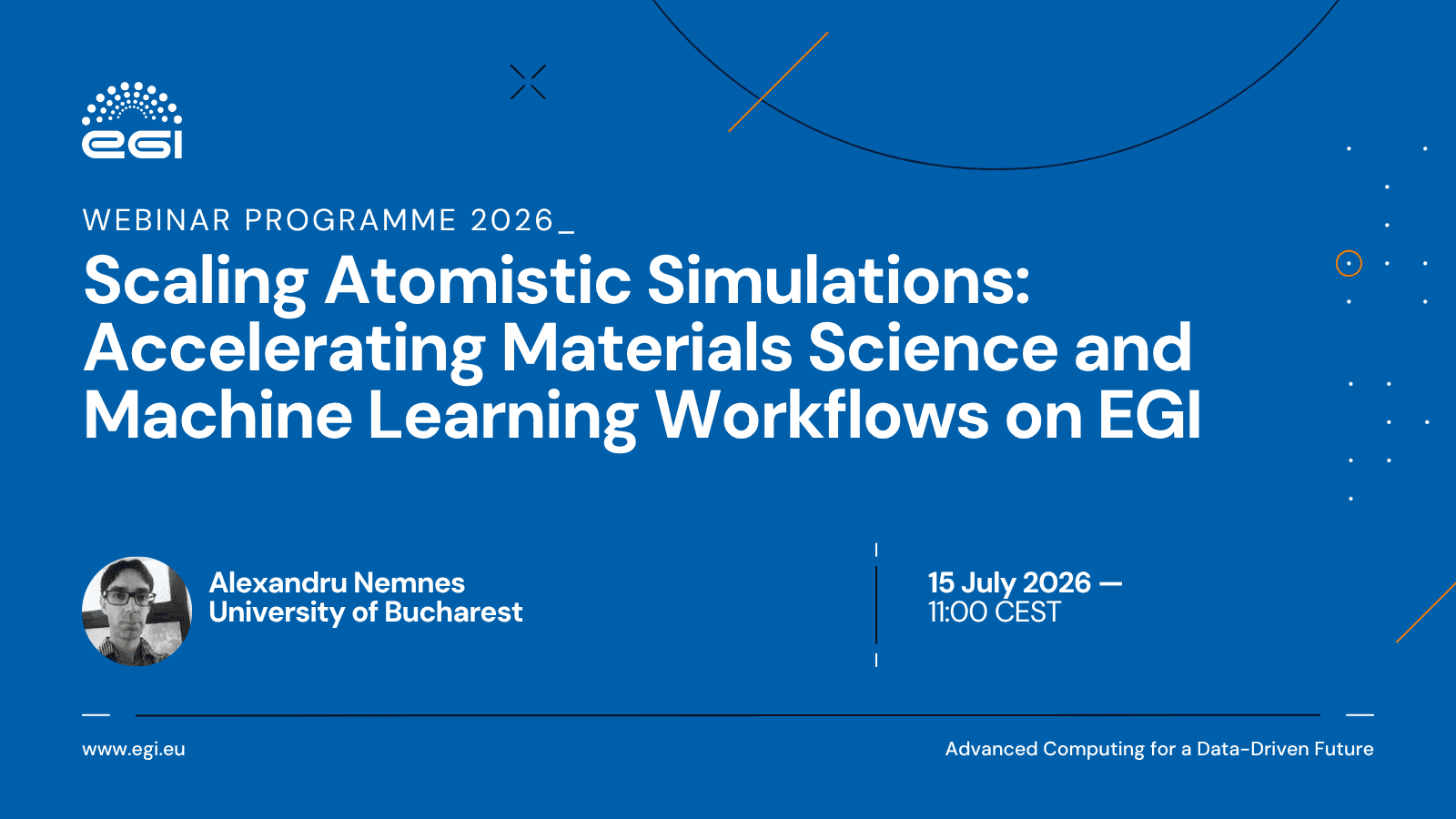
Webinar: Scaling Atomistic Simulations: Accelerating Materials Science and Machine Learning Workflows on EGI
About the webinar
We present recent progress in modelling layered nanostructures based on ab initio density functional theory (DFT) calculations, with the focus on hybrid perovskite materials used in photovoltaic applications. The simulations were performed in the framework of the PERLA-PV project using the resources provided by EGI, with the dedicated support of CLOUDIFIN.
Highly important aspects in the perovskite solar cell performance and stability concern the electronic properties of interfaces, ion migration dynamics, while simulations of the current-voltage hysteresis can be linked to solar cell degradation. The atomistic calculations, in particular, require a significant amount of computational resources as the number of atoms in the simulations typically reaches several hundred atoms. Moreover, a large number of instances, corresponding to different defect configurations and molecular dynamics runs, need to be investigated. We present here the calculations workflow in the context of the provided EGI resources.
Besides the photovoltaic applications, other recent ab initio studies were devoted to the optimisation of layered phosphorene-based nanostructures for biosensing and for establishing the conditions of hydrogen diffusion in boron structures relevant for ITER fusion reactor. More recently, machine learning models based on conditional generative-adversarial neural networks were employed for reducing the number of iterations in the self-consistent cycles in DFT calculations. Also, devices for quantum information processing like quantum sorters were designed using numerical simulations using effective mass models, which are currently extended to atomistic simulations on systems based on graphene-based materials.
Target Audience:
- Domain Scientists & Researchers (The Chemists & Physicists)
- Infrastructure & Cloud Providers (The Systems Engineers)
- AI, Machine Learning, & Quantum Developers
- Next-Generation Researchers & PhD Students
Programme
- Presentation 25′
- Demo 25′
- Q&A 10′
About the speaker
Dr. George Alexandru Nemnes is a Professor and leading computational physicist specialising in solid-state physics, nanostructures, and advanced materials modelling. He obtained his PhD in computational physics (magna cum laude) from the Technical University of Chemnitz, Germany, focusing on the parallel computing dynamics of complex systems.
Dr. Nemnes’ current research lies at the cutting edge of materials science and e-infrastructure integration. His work extensively utilises High-Throughput Computing (HTC) and Density Functional Theory (DFT) calculations to investigate the electronic, optical, and transport properties of advanced nanostructures, with a particular focus on hybrid perovskite solar cells, renewable energy materials, and quantum information devices.
As a pioneer in bridging domain science with modern computing, his recent projects heavily incorporate machine learning techniques—specifically Artificial Neural Networks (ANNs) and Generative Adversarial Networks (GANs)—to optimise and accelerate complex atomistic simulation workflows. He has successfully coordinated and led numerous national and international research initiatives (such as the PERLA-PV and OPTIM-PRV projects), leveraging federated cloud resources to drive breakthrough discoveries in materials design.
Related content

EGI delivers advanced computing services to support scientists, international projects, research infrastructures and businesses.

Solve challenges such as batch and interactive computing, data spaces and data federation, federated access.

Discover EGI Webinars & Trainings