


The EPOS–EGI collaboration illustrates how thematic Research Infrastructures and horizontal e-infrastructures can work together to address Europe’s most complex scientific challenges and build resilient, user-centric and future-proof research environments.
As the collaboration evolves, EPOS and EGI will continue to deepen service integration, explore long-term sustainability models, and jointly contribute to training and outreach, ensuring that the benefits of this collaboration extend to researchers, decision-makers, and society at large.
EPOS and EGI partner to scale computing and collaboration services for European geoscientists
Understanding earthquakes, volcanic eruptions, tsunamis, and other Earth processes requires more than isolated datasets or even single disciplines. These phenomena are governed by complex, interconnected processes that span spatial scales from laboratory experiments to continental tectonics, with temporal scales ranging from seconds to geological time. And they generate large, heterogeneous data volumes distributed across many infrastructures. The challenge facing the solid Earth science community is therefore equally digital and scientific. This challenge can be summed up in the question of, “How do we integrate, process, and analyse complex data at scale in a way that is sustainable, interoperable, and reusable?” The European Plate Observing System (EPOS) was established precisely to address this question.
EPOS is a pan-European Research Infrastructure that enables the integrated use of multidisciplinary solid Earth science data, data products, software and services, supporting both fundamental research and societal applications related to geo-hazards, geo-resources exploitation, and environmental sustainability.
Today, EPOS integrates data and services from more than 250 national research infrastructures across 26 countries, spanning domains such as seismology, volcanology, geodesy, satellite Earth observation, geomagnetism, near-fault observatories, laboratory experiments, geological modelling, anthropogenic hazards, and tsunami science.

Figure 1. EPOS ERIC Partnerships
At the heart of EPOS lies a federated digital architecture. Ten thematic communities from different domains of geoscience, known as Thematic Core Services (TCS), curate and harmonise domain-specific data and services. A central hub, the Integrated Core Services (ICS), provides common discovery, access, and processing capabilities through a one-stop-shop platform that is also programmatically accessible via APIs. This architecture enables multidisciplinary workflows and also introduces demanding requirements in terms of computing capacity, cloud orchestration, authentication and authorisation, service reliability, and long-term sustainability.
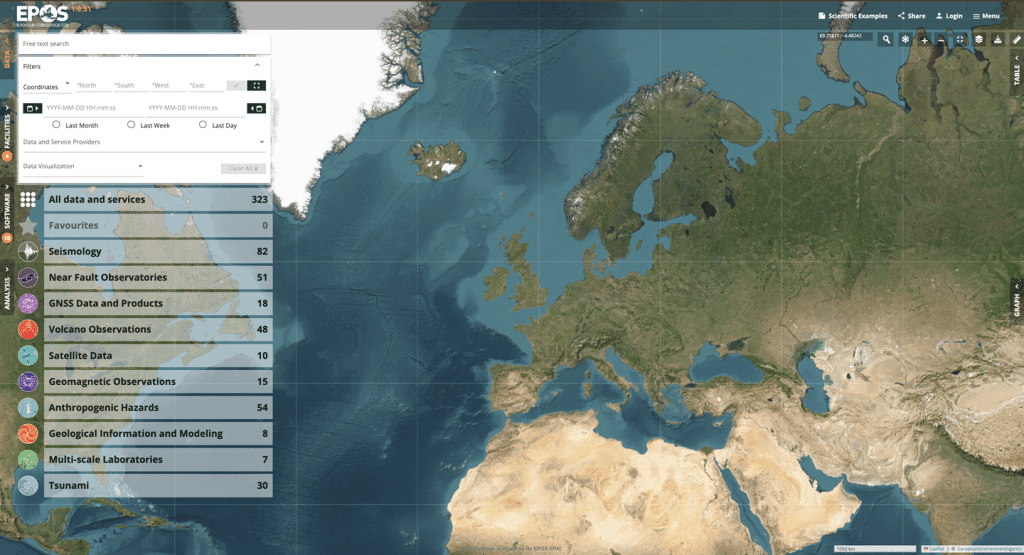
Figure 2. EPOS ERIC Platform
This is where collaboration with an established, federated e-infrastructure provider becomes strategic, and where EGI enters the picture.
How EGI Services Enable EPOS Operations and Innovation
EGI provides scalable computing, storage, data management, and analytics services to research communities worldwide. Through its cloud, high-throughput, and federated computing capabilities, EGI offers exactly the type of flexible and sustainable “digital backbone” required for a distributed infrastructure such as EPOS.
The Memorandum of Understanding between EPOS ERIC and EGI establishes the foundation for a long-term collaboration in which EPOS gains a robust digital backbone, and EGI extends its services to a new, data-intensive scientific community whose real-world use cases can drive service evolution, testing, and innovation. A pivotal element of this collaboration is the support for the computational component of the EPOS Platform, which consists of a distributed environment designed to provide future computing and storage resources for running data processing, modelling, and analysis workflows.
Through this partnership, EGI supports EPOS in several concrete ways:
- Federated computing infrastructure: EGI resource centres provide cloud and computing capacity that underpin the EPOS computing platform, enabling data processing, modelling, and analysis services to run close to the data and scale, according to demand.
- Service quality and sustainability: The collaboration defines Service Level Agreements (SLAs) and Operational Level Agreements (OLAs) to ensure reliability, performance monitoring, and long-term sustainability of EPOS digital services.
- Authentication and authorisation: By aligning with EGI Check-in and federated AAI solutions, EPOS simplifies secure access to services across national boundaries, supporting seamless user experiences, in line with European Open Science Cloud (EOSC) principles.
- Interactive analysis environments: EGI Notebooks enable EPOS to offer Jupyter-based environments for data exploration, training, and community schools, lowering the technical barrier for users and fostering reproducible science.
- User support and competence centres: Through EGI’s federated support model, EPOS researchers benefit from domain-aware technical assistance, accelerating onboarding and problem resolution.
The collaboration is not limited to infrastructure provisioning. It includes joint requirements gathering, co-development, testing, and validation, ensuring that EGI services evolve in response to real scientific use cases emerging from the solid Earth science community.
Delivering Value to the EPOS Community
For the EPOS community, the value of collaborating with EGI extends well beyond access to cloud hosting resources. It fundamentally strengthens EPOS’s ability to deliver on its mission of sustainable, open, and multidisciplinary science.
The collaboration enables operational robustness. By relying on a federated European infrastructure rather than isolated, project-based solutions, EPOS can offer stable services that persist beyond individual funding cycles. This is critical for national research infrastructures and scientific communities that depend on EPOS as a long-term reference platform.
By enhancing scientific innovation through this collaboration, EPOS envisions EGI playing a key role in enabling access to scalable computing and interactive notebooks so that advanced analytics can be made possible in order to apply data-intensive and AI-driven methods across EPOS datasets in the future. This opens new research avenues, from high-resolution seismic imaging to near-real-time deformation analysis and integrated hazard assessment.
This collaboration also reinforces alignment with EOSC in the context of the forthcoming ENVRI node, where EGI acts as the key technological and e-infrastructure partner. EPOS's data and services are naturally positioned to be discoverable, accessible, and reusable, aligning well with the common vision of federating resources from diverse environmental Research Infrastructures in Europe in the broader EOSC ecosystem. This will contribute to enhancing the visibility of EPOS assets and support their reuse well beyond the solid Earth science community.
Finally, the collaboration fosters community building and skills development. Joint training events, competence centres, and outreach activities help equip researchers with the digital skills needed to fully exploit modern e-infrastructures, while strengthening ties between Earth scientists and e-infrastructure experts.
A Shared Vision for the Future
The EPOS–EGI collaboration illustrates how thematic Research Infrastructures and horizontal e-infrastructures can work together to address Europe’s most complex scientific challenges and build resilient, user-centric and future-proof research environments.
As the collaboration evolves, EPOS and EGI will continue to deepen service integration, explore long-term sustainability models, and jointly contribute to training and outreach, ensuring that the benefits of this collaboration extend to researchers, decision-makers, and society at large.
EGI, a European landmark infrastructure for scientific computing, celebrated its 20th anniversary in 2023, marking
Read about the development of the Italian Research Infrastructure and the ongoing initiatives supporting it