
Bridging Distributed Computing and AI for Science: EGI at CHEP 2026
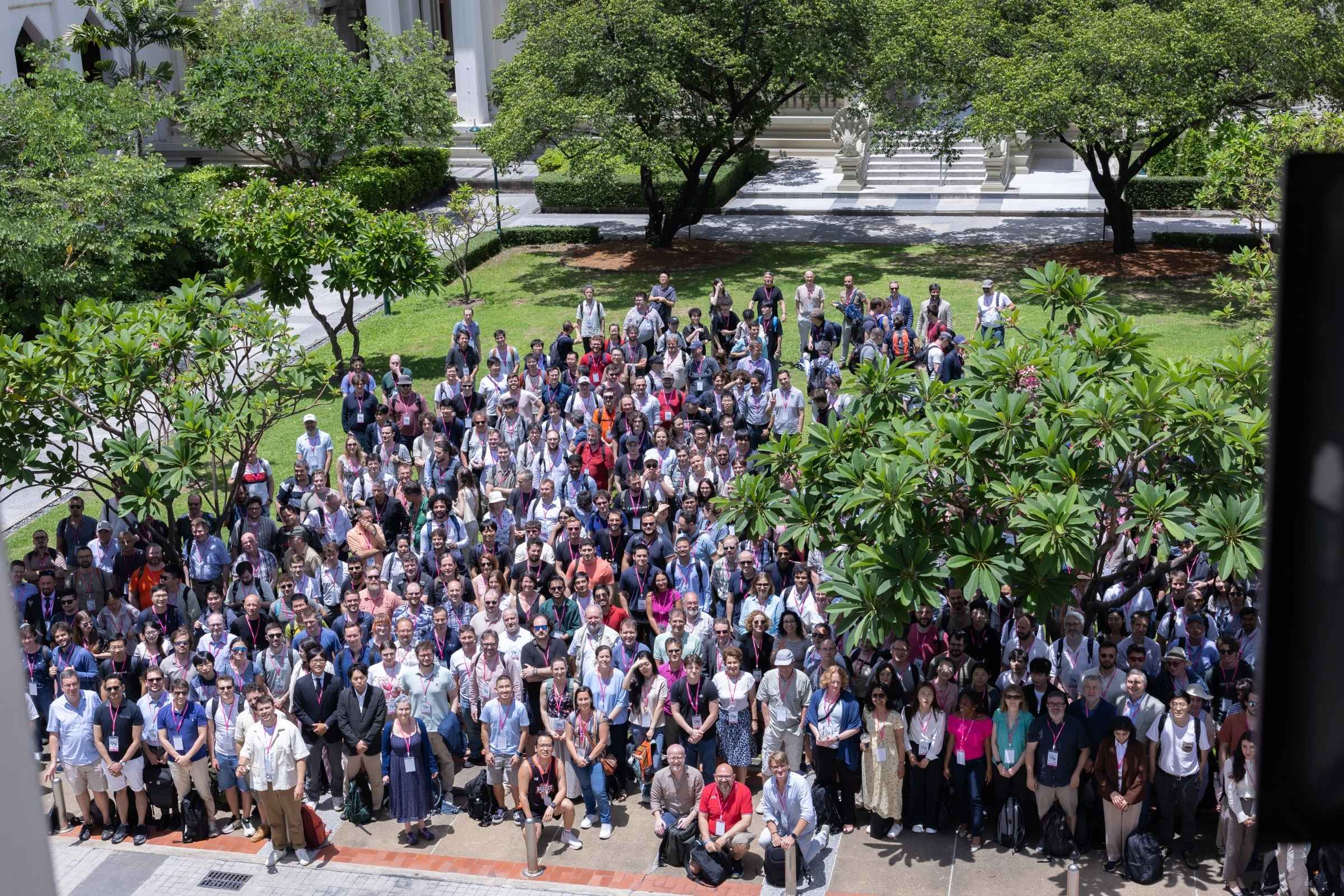


The 28th Conference on Computing in High Energy and Nuclear Physics (CHEP 2026) took place from 25 to 29 May 2026 at Chulalongkorn University in Bangkok, Thailand. This long-standing event serves as a premier global platform for particle and nuclear physics computing experts to address networking, software, and infrastructure challenges for the world’s leading data-intensive scientific experiments.
Coinciding with the final week of LHC Run 3 operations and looking ahead to the High-Luminosity LHC (HL-LHC) era, CHEP 2026 brought together over 500 participants to discuss emerging topics such as sustainable computing, green data centres, and interdisciplinary data applications.
EGI’s AI-Ready Strategy
A central highlight of EGI's participation was the presentation "AI in the EGI e-infrastructure - Past experiences and future strategies," delivered on 26 May by Sergio Andreozzi, Head of Strategy, Innovation and Communications at the EGI Foundation.
Speaking during Track 4 (Distributed Computing), Sergio Andreozzi outlined how the recently approved EGI Federation Strategy 2026–2030 will steer EGI's evolution into Europe's AI-ready compute and data continuum.
"AI now reaches into every stage of research: detecting rare events in instrument data, designing new molecules and materials, replacing slow simulations with fast surrogate models, even running autonomous experiments and mining the scientific literature. EGI's role is to put this within reach of every research community by building a sovereign, AI-ready compute-data continuum: federated GPUs, AI-ready data, and trusted AI services that researchers across Europe can use while keeping their data under their own control.” — Sergio Andreozzi, Head of Strategy, Innovation and Communications at the EGI Foundation
EGI showcased how recent flagship initiatives like iMagine and InterTwin have successfully deployed AI frameworks across shared national facilities. Looking forward, EGI is accelerating this trajectory through several ongoing projects:
- EOSC Data Commons: Establishing a trusted Research Commons with integrated AI tools.
- RI-SCALE: Developing data exploitation platforms that pair research infrastructure data holdings with high-performance cloud and computing providers.
- SCIANCE: Building the foundations for the Resource for AI Science in Europe (RAISE) programme to pool compute resources, expert talent, and specialised datasets.
- SPECTRUM: Delivering the strategic and technical frameworks needed to connect European digital infrastructures for the exascale era of data-intensive science.
Other EGI Federation Contributions
EGI members and partners contributed to several other core operational tracks during the conference, including:
- Global Grid User Support (GGUS) for WLCG and EGI: From Legacy to Next-Generation Helpdesk: Pavel Weber (Karlsruhe Institute of Technology) presented on the evolution of the core EGI Helpdesk from a legacy system into a next-generation helpdesk designed to support the modern operational needs of both the WLCG and EGI communities.
- SPECTRUM: A Strategic Framework and Technical Blueprint for European Exascale Research Data and Compute Infrastructure: Sergio Andreozzi introduced the final results from SPECTRUM, a strategic framework and technical blueprint aimed at cementing a technical foundation for European exascale research data and compute infrastructure.
- Next-Generation Accounting Architecture for WLCG and EGI: Panos Paparrigopoulos (CERN) delivered a presentation on ongoing architectural enhancements to the WLCG and EGI accounting systems, ensuring infrastructure resource tracking scales effectively with upcoming cross-border research demands.
The future of data-intensive science relies on sustained collaborative innovation that spans geographical boundaries and disciplines.
Related content
SPECTRUM brings together leading European science organisations and e-Infrastructure providers to formulate a Strategic Research,
RI-SCALE empowers Research Infrastructures by providing scalable computational platforms for AI-driven data analysis, improving data
Shaping the development of RAISE and facilitating AI-enabled scientific research in Europe.