Diego Scardaci (left) representing EOSC Mesh at the official MoU signing in Florence
Updated 16/10/2026
EOSC Association and Leading Horizon Europe Projects Sign MoU to Advance the EOSC Federation Architecture
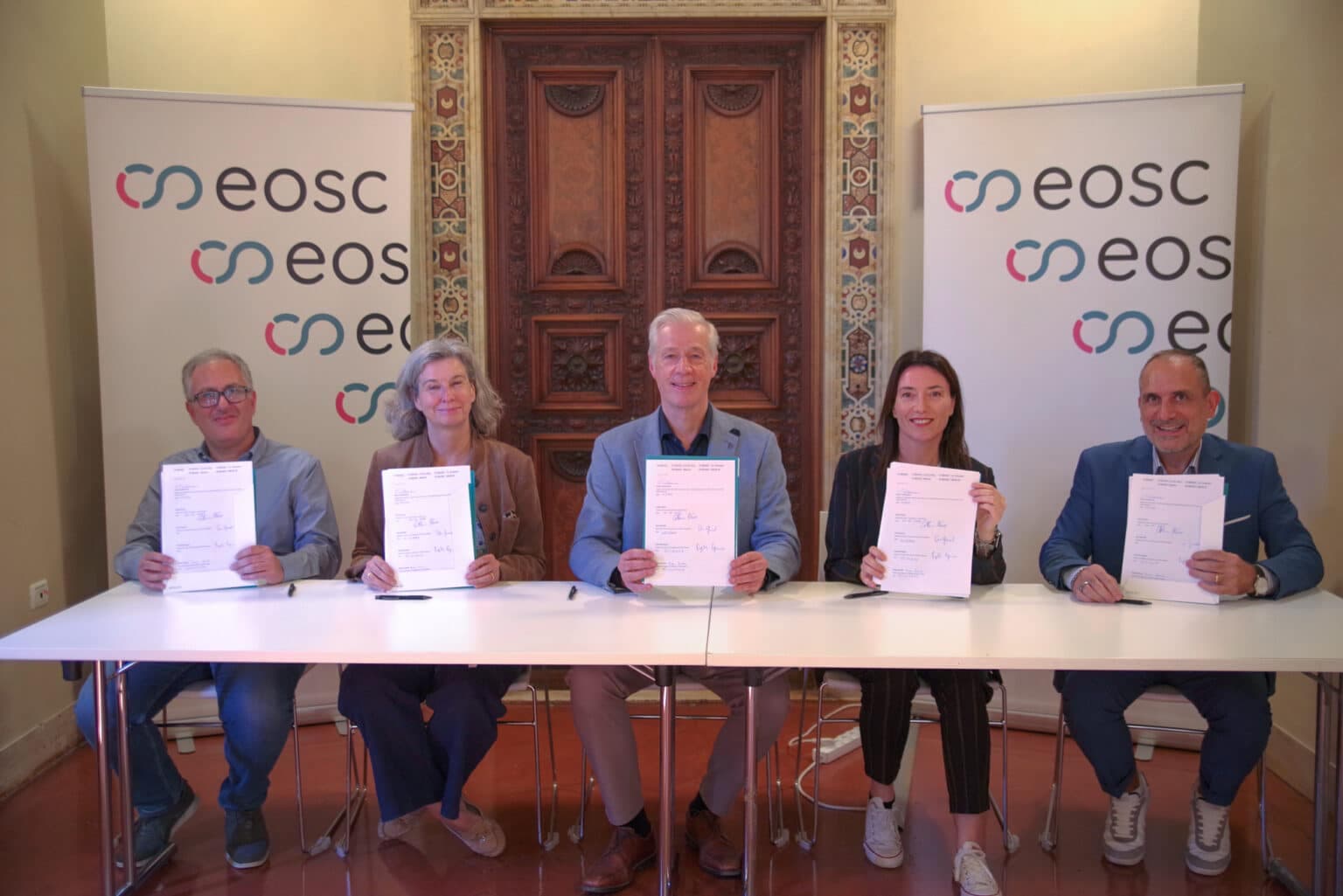
The EOSC Association, coordinator of EOSC Gravity and EOSC United, and four newly launched projects (EOSC4ALL, EOSC-CONNECT, EOSC-Marine, and EOSC Mesh) have formally signed a Memorandum of Understanding (MoU).
This collaboration will allow the establishment of a joint framework to align technical architectures, governance, engagement strategies, and sustainability efforts across the EOSC ecosystem. The partnership aims to achieve a greater impact on the build-up of the EOSC Federation than any single project acting in isolation.
Building a Distributed, Scalable EOSC Federation Architecture
A central focus of the collaboration is evolving the federation’s technical architecture. The participating projects will share technical knowledge, align interface standards and operational practices, and integrate federating capabilities. Coordinated by the EOSC Association with support from the EOSC United project, the partners will develop a detailed technical roadmap to guide the transition toward a more distributed architecture, such as a multi-hub or full-mesh model.
Key objectives of the collaboration include:
- Technical standardisation: document and align common standards, protocols, and APIs for metadata, authentication, and data access.
- Roadmap and piloting: define implementation timelines and conduct piloting activities to validate evolutions of the Federation architecture.
- Stakeholder engagement: consult with the EOSC EU Node and submit technical roadmaps for endorsement by the Node Coordinators Committee within the EOSC Federation interim governance structure.
- Unified engagement and sustainability: create joint engagement plans to streamline outreach across node countries and research communities, and share key exploitable results and sustainability models in line with open science principles.
Timeline and Implementation
The partners will establish coordination structures and finalise execution plans for their joint activities by the end of 2026, with implementation starting in 2027. The agreement remains active through the projects’ lifecycle until 31 August 2029.
EGI Perspective
Underlining a unified vision for European open science and federated digital research infrastructures, the EGI Foundation has formally endorsed the newly established MoU among European e-Infrastructures. Speaking on this milestone, Tiziana Ferrari, Director, EGI Foundation, stated:
“EOSC Mesh (Connecting Nodes to Advance the EOSC Federation) mobilises a consortium of 30 partners and 16 affiliated entities across European e-infrastructures, research infrastructures, national nodes, and technology providers and serves as a primary vehicle for operationalising the EOSC Federation".
How the EGI Federation Contributes to EOSC Mesh
The EGI Foundation coordinates the EGI Federation, an international collaboration that brings together physical and virtual compute and data nodes across Europe and worldwide to provide advanced computing services for research and innovation.
As project coordinator and a pillar of Europe’s distributed computing landscape, the EGI Federation will drive several core technical, operational, and architectural contributions to the newly launched EOSC Mesh.
The EGI Federation will establish and enrol the EGI Node directly into the EOSC Federation, contributing advanced cloud, high-throughput compute, and federated data services. EGI ensures that researchers across Europe gain seamless access to production-grade digital capacities that meet EOSC compliance, quality, and security criteria.
EGI will also spearhead the delivery of 25 shared federating capabilities through the collaborative EOSC Mesh Hub. Leveraging decades of operational expertise, EGI contributes production-ready core and generic services, including
- Core Capabilities: Federated Authentication and Authorisation Infrastructure (AAI), federated accounting, service monitoring, helpdesk ticketing, and FitSM-compliant Service Management Systems (SMS).
- Generic Execution & Orchestration: Infrastructure Manager (IM), cloud container orchestration, interactive Jupyter Notebooks, distributed data transfer, CVMFS, and sensitive data processing environments.
To move beyond centralised bottlenecks, EGI and its consortium partners are validating a resilient, multi-hub operational topology aligned with the EOSC Federation Handbook. This approach ensures high fault tolerance, localised governance, and domain-specific customisation, enabling thematic and national nodes to interconnect smoothly with the wider EOSC ecosystem.
EGI is leading the definition of long-term business, cost-recovery, and credit-management models for cross-node resource consumption, providing future node operators with validated frameworks, legal templates, and operational best practices.
Through these concerted efforts, the EGI Federation reaffirms its dedication to turning the vision of an interconnected, researcher-centric European Open Science Cloud into an operational reality.