
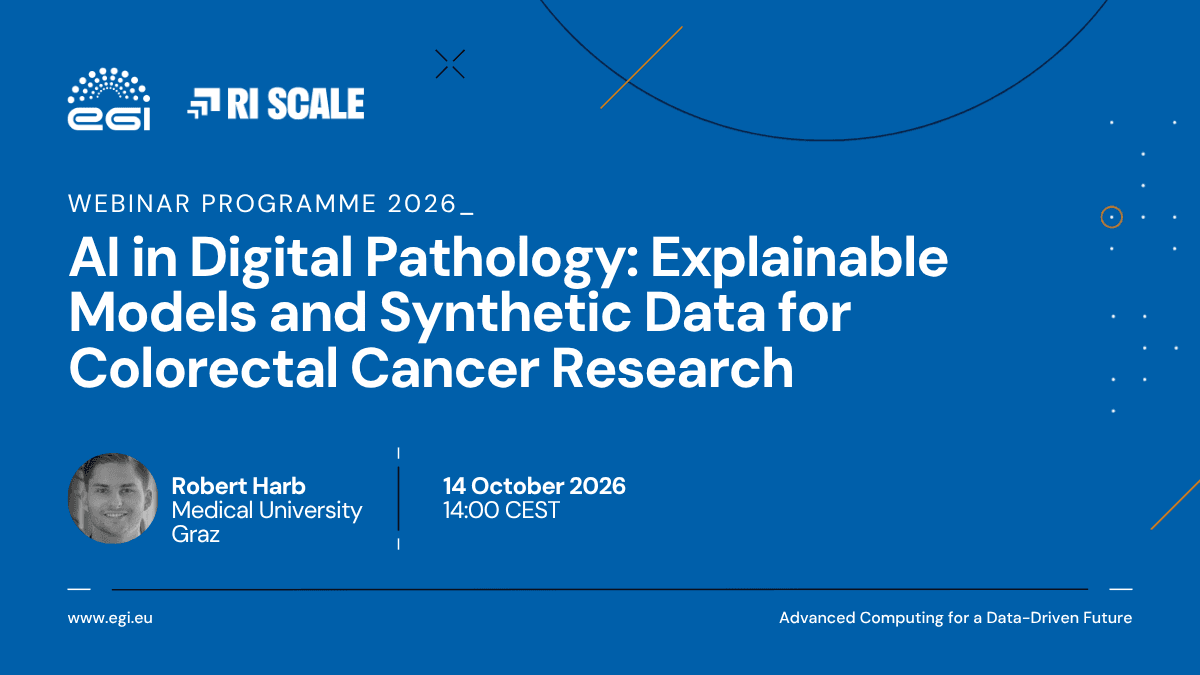
RI-SCALE - AI in Digital Pathology: Explainable Models and Synthetic Data for Colorectal Cancer Research
About the webinar
This webinar highlights how the RI-SCALE Data Exploitation Platform (DEP) empowers European biobanking and digital pathology through two synergistic AI use cases:
Colorectal Cancer (CRC) Risk Prediction with Explainable AI: Demonstrates weakly supervised AI models trained on over 45,000 whole-slide lymph node images to identify novel, invisible biological biomarkers and improve clinical risk stratification.
Synthetic Histopathology Data Generation: Explores state-of-the-art diffusion models designed to generate ultra-high-resolution, synthetic whole-slide images (WSIs). This approach solves privacy and data-sharing bottlenecks, enabling scalable AI model training without risking patient privacy.
Together, these use cases demonstrate how scalable compute and FAIR data access via the DEP accelerate cancer research, clinical diagnostics, and privacy-compliant data sharing across Europe.
Target Audience
- Oncologists, pathologists, and clinicians seeking AI-driven diagnostic and biomarker discovery tools
- AI/ML researchers in medical imaging and computational pathology
- Biobank custodians, data managers, and RI operators handling sensitive clinical data
- Developers of privacy-preserving and FAIR data-sharing technologies in healthcare.
Agenda
- Presentation
- Q&A
About the speaker
Robert Harb is a computer scientist and researcher based at the Diagnostic and Research Institute of Pathology at the Medical University of Graz (Research Team Müller). His research focuses on data science, digital pathology, and artificial intelligence in bioimaging. Specifically, he works on processing and analyzing complex pathology datasets, developing standardized multi-layer tissue maps for AI applications, and exploring gigapixel-scale, diffusion-based synthetic whole-slide image (WSI) generation to support AI training and FAIR data sharing in medical research.is a computer scientist and researcher based at the Diagnostic and Research Institute of Pathology at the Medical University of Graz (Research Team Müller). His research focuses on data science, digital pathology, and artificial intelligence in bioimaging. Specifically, he works on processing and analyzing complex pathology datasets, developing standardized multi-layer tissue maps for AI applications, and exploring gigapixel-scale, diffusion-based synthetic whole-slide image (WSI) generation to support AI training and FAIR data sharing in medical research.
Related content
Join the RI-Scale Open Call Webinar and benefit from the RI-Scale ecosystem
with Ville Tenhunen (EGI Foundation)
March 25 2026 14:00 CET

RI-SCALE empowers Research Infrastructures by providing scalable computational platforms for AI-driven data analysis, improving data

Using EISCAT and ENES as examples, we demonstrate how will the Data Exploitation Platforms of
RI-SCALE Webinar Series