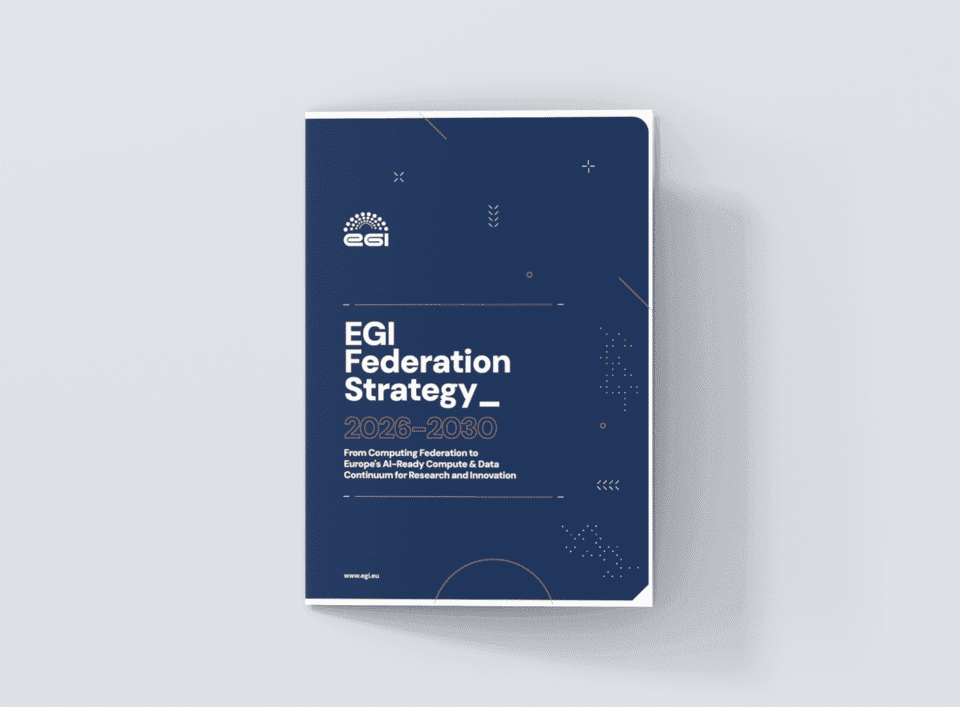
The EGI Council approved the EGI Federation Strategy 2026–2030 on 27 November 2025, and the strategy is now publicly available. Built on 20 years of federating computing resources across Europe, it sets out how EGI will evolve from a computing federation into Europe’s AI-ready compute-data continuum for research and innovation.
Updated 26/03/2026
EGI publishes its Federation Strategy 2026-2030
Advancing Europe’s federated AI-ready compute-data continuum


Responding to trends in European research
The strategy responds to five trends reshaping research infrastructure:
- Open science now requires systems that can maintain trust and resilience across jurisdictions, as geopolitical pressures test international collaboration
- AI in research has moved from specialised tool to standard expectation; the European Commission’s RAISE initiative recognises this by pooling compute, data, and expertise for AI in science
- Cross-domain infrastructure demand is growing as more scientific fields require horizontal computing and data services simultaneously
- Digital sovereignty is moving from principle to operational requirement, backed by the EU’s 2025 Strategy on Research and Technology Infrastructures
Workforce capacity remains a bottleneck: professionals who combine infrastructure expertise with research domain knowledge are scarce.

Towards an AI-ready compute-data continuum
By 2030, EGI aims to be Europe’s essential federated AI-ready compute-data continuum for research communities, where innovation and investment compound for pan-European impact.
In practice, this means building a trusted, sovereign infrastructure where researchers can access the computing power, data resources, and expertise they need across borders and disciplines. The strategy builds on three interconnected value streams:
- Powering the Federation: the platforms, policies, and governance that hold a multi-country infrastructure together
- Enabling Scientific Computing: access to AI-ready computing, data, and support services for research communities
- Enabling Sustained Innovation: collaborative R&I coordinated across the federation so that innovations persist beyond individual project lifecycles
These value streams are advanced through three strategic pillars. The first, Sovereign Compute-Data Federation, focuses on integrating a European compute-data ecosystem and building AI-ready research infrastructure. The second, Incentivised Cross-Border Access, addresses the policy and funding barriers that limit resource sharing across borders. The third, a Resilient Innovation Ecosystem, positions EGI as a collaborative R&I actor where innovations developed through community-led groups and joint programmes persist beyond individual project lifecycles.
“EGI does two things at once: we deliver production services that research communities depend on every day, and we run collaborative R&I that shapes how data-intensive science will work in the future. This strategy connects those two sides. What we learn through research feeds back into operational services that the whole federation can use. That cycle of innovation into practice, multiplied across a connected ecosystem of providers, research communities, and national organisations, is how national investments compound into pan-European impact.” - Sergio Andreozzi, Head of Strategy, Innovation and Communications, EGI Foundation
Explore the Full Strategy
Read the full EGI Federation Strategy 2026–2030 and discover how EGI is shaping the future of data-intensive research in Europe.
Elected Members of the Task Force
The process was guided by a dedicated task force composed of members from the EGI Council and the EGI Foundation.
Sabine Crépé-Renaudin

CNRS Director of Research
EGI Council Representative of France
Pierre-Étienne Macchi

IN2P3 Director of Computing Centre
EGI Executive Board Member
Raymond Oonk

Senior Consultant at SURF
EGI Nominated expert for Netherlands
Miroslav Ruda

CESNET Head of Distributed Computing
EGI Council Representative of Czech Republic
Matthias Schramm

Project Coordinator on Big Earth Observation Data for Environment
EGI Council Representative of Austria
Philipp Wieder

GWDG Deputy Head
Professor Data Science Infrastructures, Univ. Göttingen
EGI Nominated expert for Germany – TF Chair
Tiziana Ferrari

EGI Foundation Director
Sergio Andreozzi

EGI Foundation Head of Strategy, Innovation and Communications
Gergely Sipos

EGI Foundation Head of Services, Solutions and Support
Acknowledgements
We thank the members of the EGI Federation Strategy Task Force for their dedication, expertise, and contributions in drafting this strategy:
We also extend our sincere gratitude to the entire EGI community who participated in the survey and shared their insights. Your contributions were invaluable in shaping a strategy that reflects the real needs and aspirations of Europe’s research ecosystem.
Their collective effort ensures that the EGI Federation Strategy 2026–2030 is not only a roadmap for AI-ready compute and data infrastructure but also a shared vision for the future of data-intensive research in Europe.